
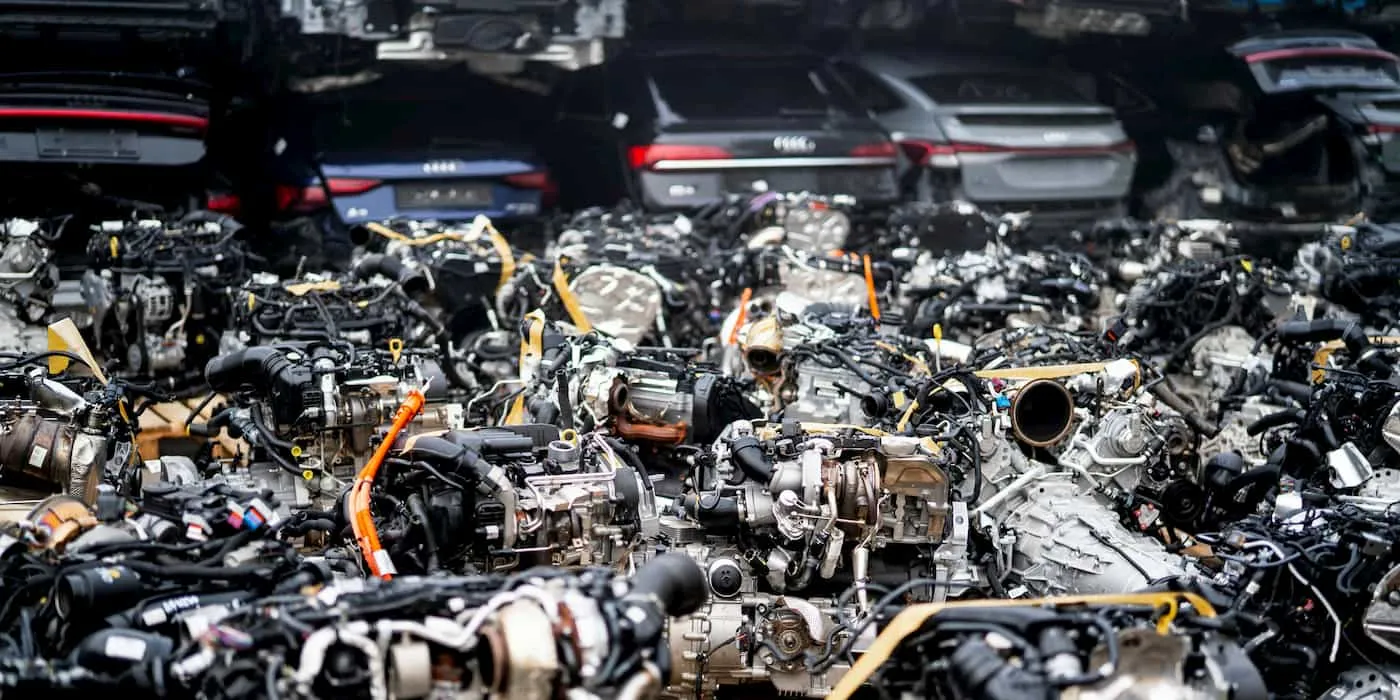
A new materials breakthrough could reshape how the auto industry recycles aluminum. Researchers report that compositionally mixed aluminum scrap from end-of-life vehicles — long considered unsuitable for high-grade reuse — can now be directly transformed into high-performance aluminum sheet in a single processing step.
The study, led by Stefan Pogatscher and colleagues and reported in Nature Communications, builds on a growing push to decarbonize metals production and reduce dependence on energy-intensive primary aluminum smelting.
A Recycling Bottleneck in Modern Vehicles
Today’s cars incorporate dozens of specialized aluminum alloys engineered for strength, corrosion resistance, crash performance and manufacturability. Automakers such as Ford Motor Company and Tesla, Inc. have steadily increased aluminum content to cut vehicle weight and improve fuel efficiency or battery range.
But that alloy diversity creates a major recycling problem.
When vehicles reach end of life, they are shredded and mechanically sorted. The result is a mixed aluminum scrap stream containing various alloying elements — magnesium, silicon, copper, manganese and others — in unpredictable proportions. Traditionally, such scrap has been “downcycled” into cast products with lower performance requirements or diluted with large amounts of primary aluminum to meet strict composition limits.
This inefficiency runs counter to circular economy goals, particularly given that producing primary aluminum is among the most electricity-intensive industrial processes.
Rethinking “Impurities”
Historically, metallurgists viewed the mixed chemistry of automotive scrap as a liability. As molten aluminum cools, residual alloying elements form hard intermetallic particles — microscopic compounds that can be brittle and act as crack initiation sites. These features have typically been treated as defects that degrade mechanical performance.
Pogatscher’s team challenged that assumption.
Drawing inspiration from prior advances in steel metallurgy, where carefully engineered intermetallic phases can enhance strength without sacrificing ductility, the researchers proposed that impurity-rich particles in aluminum scrap might be harnessed rather than eliminated.
Instead of attempting costly separation or purification, the team developed a thermomechanical processing route that controls how these particles form and distribute within the metal’s microstructure. Under the right conditions, the intermetallic phases refine grain size and contribute to strengthening mechanisms — effectively turning a liability into a performance advantage.
Direct Upcycling in a Single Step
The process enables mixed automotive scrap to be converted directly into high-performance aluminum sheet suitable for demanding applications, without the traditional need for extensive alloy sorting or dilution with virgin material.
This “direct upcycling” approach contrasts sharply with conventional recycling models. Rather than downgrading material quality, it preserves — and in some cases enhances — mechanical properties through microstructural engineering.
If scalable, the implications could be significant:
- Lower carbon footprint: Recycling aluminum requires roughly 5% of the energy needed for primary production. Maximizing closed-loop reuse could dramatically reduce emissions.
- Reduced raw material demand: Less reliance on bauxite mining and energy-intensive refining.
- Improved supply resilience: Domestic scrap streams could supply high-value manufacturing without heavy dependence on global commodity markets.
Implications for the Auto and Metals Industries
As vehicle electrification accelerates, aluminum use is expected to rise further due to lightweighting demands. The ability to directly upcycle mixed scrap into sheet products could help automakers close the materials loop and meet tightening sustainability targets.
The findings also challenge long-standing metallurgical doctrine — showing that so-called impurities, when precisely controlled, can serve as functional design elements.
While industrial adoption will require further validation at scale, the research signals a shift in how materials scientists think about scrap. Rather than chasing perfect chemical purity, future recycling strategies may increasingly focus on engineering microstructures that capitalize on real-world complexity.
In a world seeking both resource efficiency and decarbonization, turning mixed aluminum scrap into high-value sheet in a single step could mark a pivotal advance in sustainable metals manufacturing.