President Donald Trump is pressing ahead with his trade agenda despite a landmark decision by the Supreme Court of the United States that invalidated the legal foundation for many of his sweeping tariffs — and cast uncertainty over a year’s worth of newly negotiated trade agreements.
In a ruling issued last week, the high court found that the administration overstepped its authority by imposing broad-based tariffs under the International Emergency Economic Powers Act (IEEPA). The decision effectively dismantled the emergency framework that had underpinned duties on imports from dozens of countries.
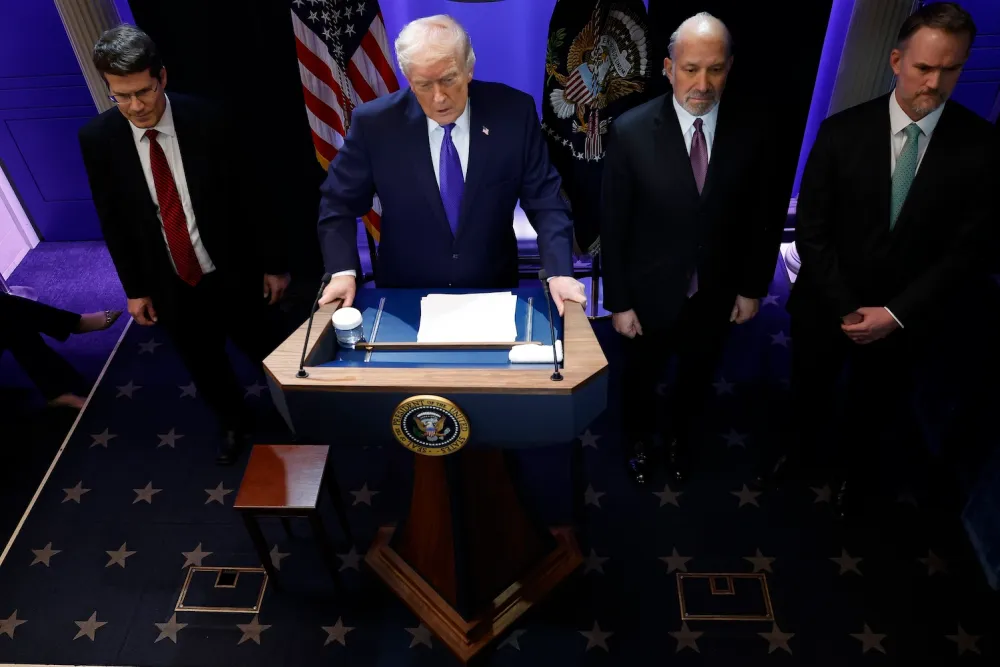
Speaking during his State of the Union address, Trump dismissed concerns that the ruling would derail existing trade deals. He argued that foreign governments and multinational firms remain committed to agreements reached under the now-invalidated tariff structure. At the same time, he warned that countries attempting to revisit terms could face steeper levies under alternative trade statutes.
Within days of the decision, the administration pivoted, announcing a 10% across-the-board tariff under Section 122 of the Trade Act of 1974. Officials have also floated the possibility of increasing that rate to 15%, though no formal timeline has been provided.
Legal Reset, Diplomatic Recalibration
The court’s ruling has left trading partners reassessing the concessions they made in exchange for preferential tariff treatment. Many agreements were explicitly structured around IEEPA-based rates — a legal pillar that no longer stands.
Johannes Fritz, head of the St. Gallen Endowment for Prosperity through Trade, said governments now face a fundamental question: whether Washington can replicate those arrangements using different authorities, such as Section 301 of the Trade Act, which requires formal investigations into unfair trade practices before tariffs can be imposed.
Such processes, he noted, are slower and more procedurally complex, raising doubts about how quickly — or smoothly — the administration can reconstruct its trade framework.
Winners and Losers Emerge
Analysts say the ruling may reshuffle the geopolitical balance among U.S. partners.
Countries that swiftly negotiated tariff reductions following last year’s “Liberation Day” duties could find themselves disadvantaged. Sarang Shidore of the Quincy Institute suggested that early dealmakers effectively traded concessions for legal guarantees that have now evaporated.
Conversely, governments that resisted U.S. demands — including Brazil — may feel vindicated, having avoided binding commitments tied to an unstable legal mechanism.
In Asia, the spotlight has turned to Japan, which previously secured a reduction in reciprocal tariffs to 15% in return for pledging $550 billion in U.S.-directed investment. With Washington now applying a universal 10% rate, questions are emerging about whether Tokyo effectively paid a premium for terms that others may now receive automatically.
Japan’s trade minister, Ryosei Akazawa, urged U.S. officials not to impose additional burdens beyond the earlier bilateral agreement, warning that uniform tariffs could undermine the spirit of last year’s negotiations.
Deals on Hold
Elsewhere, momentum has stalled.
India has temporarily paused work on an interim trade pact, with officials indicating they will resume discussions once greater legal clarity emerges in Washington.
Meanwhile, the European Parliament has twice delayed a vote on a transatlantic arrangement that would have locked in a 15% U.S. tariff ceiling on most EU exports while reducing European duties on American industrial goods.
Uncertain Path Forward
Although the White House insists it retains ample authority to pursue its trade objectives, the Supreme Court’s intervention has introduced new volatility into global commerce. Allies are weighing whether to recommit to revised terms, renegotiate from scratch, or wait for a more stable legal footing.
For now, the administration’s message is clear: the tariff campaign continues — even if the rules governing it have changed.