The prospect of another U.S. war with Iran is no longer remote. What remains far less clear is the objective. Without a defined endgame, any escalation risks becoming an open-ended confrontation with unpredictable consequences for both countries — and for the broader region.
President Donald Trump is reportedly weighing a limited strike designed to pressure Tehran back to negotiations with greater concessions. Yet he faces constraints of his own making. After withdrawing during his first term from the 2015 nuclear agreement, he set demands that exceeded what Washington arguably requires and what Iran’s leadership was ever likely to accept. That leaves little room to de-escalate without appearing to retreat.
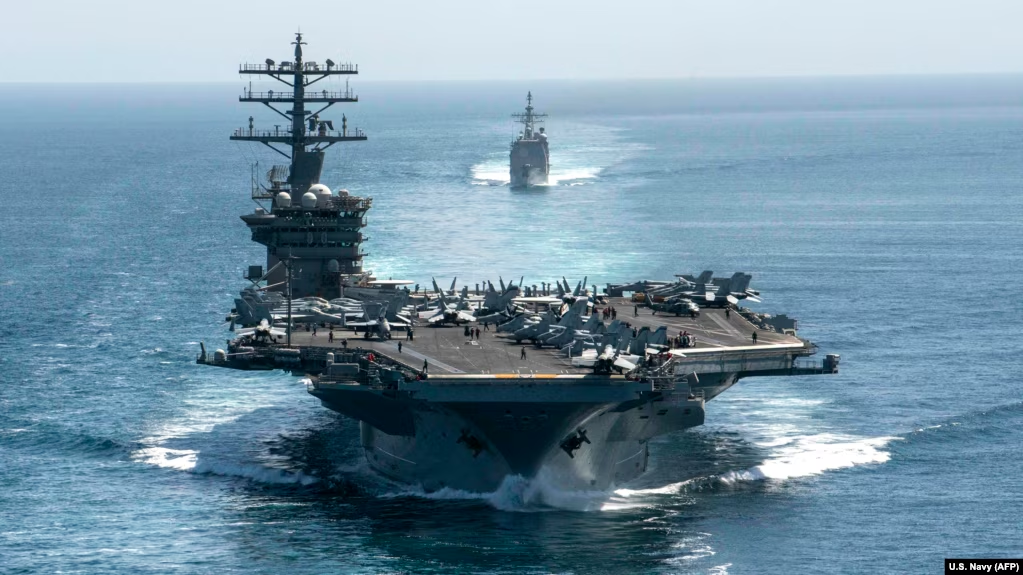
Two U.S. carrier strike groups are now positioned off Oman, an expensive and highly visible show of force. Once deployed, such assets create pressure to act. Trump has indicated a 10- to 14-day window for developments, but political and military dynamics could compress that timeline.
Iran’s Supreme Leader Ali Khamenei is equally boxed in. Decades of anti-American rhetoric and ideological rigidity limit his flexibility. From his perspective, confrontation may appear less dangerous than accepting U.S. and Israeli demands that could weaken the regime’s grip on power.
Public opinion in the United States suggests little appetite for war. Polling earlier this year showed a large majority opposed to military action and in favor of congressional authorization before any strike. For Iran, conflict would almost certainly bring economic devastation and civilian suffering — even if elements of the regime frame resistance in ideological terms.
Israel’s calculus differs. Tehran’s leadership openly supports forces hostile to the Jewish state, creating a strategic argument in Jerusalem for preemptive action — though the long-term consequences remain uncertain. Inside Iran, where security forces reportedly cracked down harshly on recent protests, some citizens may view external pressure as a catalyst for change.
Recent history may also be influencing Washington. Israeli operations against Hezbollah and prior limited strikes against Iranian targets met relatively little retaliation. Even a high-profile U.S. B-2 bomber mission last June generated minimal blowback. Earlier operations abroad likewise produced no sustained spike in oil prices or domestic political costs. But past successes do not guarantee similar outcomes in a broader conflict.
Last year’s fighting lasted less than two weeks and still resulted in significant casualties on both sides, including civilians. Now, as the United States assembles its largest regional force posture since the Iraq invasion in 2003, the stakes appear higher.
Before launching another campaign, the administration faces a fundamental task: explaining its purpose. Is the goal to force stricter nuclear and missile limits? To weaken or topple the regime? To deter further regional aggression? Or simply to degrade military capabilities? Without clarity, both domestic and international support will remain fragile.
History offers cautionary lessons. In 1999, when President Bill Clinton led NATO airstrikes against Serbia to halt ethnic cleansing in Kosovo, the mission’s objective was clearly articulated and debated. Even so, that precedent has since been invoked by others — including Vladimir Putin — to justify far different actions.
Strategic ambiguity may complicate not only alliance politics but also internal Iranian dynamics. If Washington seeks regime change, its actions would need to be narrowly focused to avoid unifying the population behind hardliners. If the aim is coercive diplomacy, clear signals about achievable terms might create space for negotiation.
Ultimately, the question is not only whether war is imminent, but what success would look like — and at what cost. Without defined objectives, escalation risks producing the worst outcome for both nations and for a region already burdened by instability: prolonged conflict, economic shock and political chaos in a country of more than 90 million people.