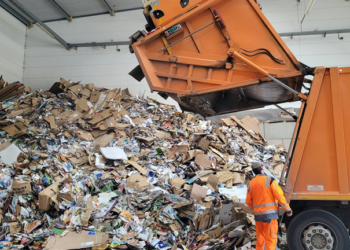
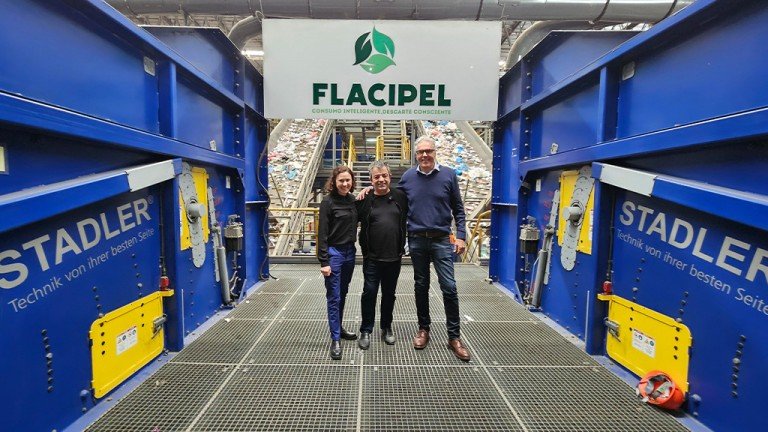
STADLER Group has delivered a purpose-built sorting facility for Flacipel Comércio de Aparas e Sucatas Ltda., part of the Multilixo Group, in Guarulhos, São Paulo. The plant is designed to handle up to 200 tonnes per day of dry mixed recyclables and to separate input streams into 21 distinct fractions, combining high-volume performance with adaptive process control. The installation marks a strategic step for Flacipel and for the region’s recycling infrastructure.
Design and capabilities
At the core of the facility is a modular sorting line that begins with a pre-sorting stage to separate material by bag color. The first classification step uses a STADLER ballistic separator to remove cardboard from the stream, after which pre-classified material is stored and fed to the main line. The main sorting line includes dosing units, bag openers, and a second ballistic separator. Advanced optical sorters, a windshifter, magnetic separators, and eddy-current devices enable recovery of a broad mix of fractions—plastics of various types and colors, films, different paper grades, cartons, metals, and RDF. The system is designed for flexibility, allowing operators to adjust equipment settings to suit each input stream and to maintain stable output quality as feed composition changes.
Flexibility was a central design goal: the team engineered a facility that maintains high performance across diverse materials without sacrificing adaptability. The modular approach, combined with STADLER’s experience with complex streams, was essential to delivering reliable results in Brazil’s recycling environment.
Operational impact
The plant’s installation took four months, with commissioning carried out by STADLER’s local team to ensure rapid knowledge transfer and a smooth ramp-up to full operation. Since going online, Flacipel’s monthly throughput has risen from about 4,800 tonnes to roughly 8,000 tonnes, delivering scale benefits, improved margins, and greater commercial leverage.
The upgrade has also strengthened Flacipel’s market position by improving recovery rates and enabling traceability across outputs. With higher capacity and stable quality, the company has begun securing new contracts, including clients seeking zero-landfill solutions for their waste streams. The facility is positioned as a trusted partner capable of handling evolving waste profiles while maintaining environmental accountability.
Long-term collaboration and regional significance
The Guarulhos project builds on a long-standing collaboration: Multilixo Group has operated a STADLER sorting line for seven years prior to this new installation, integrating a ballistic separator, a bag opener, and optical sorters. The prior project helped validate the technology under Brazilian conditions and informed the design of the 2020 facility inaugurated under the same partnership. The latest project continued this collaborative approach, with ongoing field service and maintenance support from STADLER and regular commercial visits to reinforce the relationship and use-case expansion.
Regionally, the new plant plays a pivotal role in advancing the circular economy. By enabling efficient sorting and comprehensive fraction recovery, no material is sent to landfill; outputs are directed to defined, sustainable end uses. The expansion is already prompting talks of additional upgrades, including extending the 3D sorting line to add more fractions. Experts say the project demonstrates how a well-planned facility can act as a growth engine for a recycling operation and a benchmark for advanced sorting in the country.
Outlook
STADLER views the Guarulhos plant as a model of sustained collaboration, combining performance, flexibility, and hands-on partnership. The arrangement includes ongoing inspections and preventive maintenance visits to minimize downtime, along with periodic commercial reviews to ensure the facility remains a reliable asset as Flacipel scales up its operations in Brazil’s expanding recycling market.