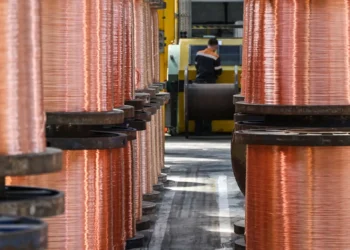
Copper prices are climbing toward record highs as industrial demand surges, but a looming supply shortfall threatens to drive costs sharply higher and complicate the global push toward electrification, according to energy historian Daniel Yergin.
Long viewed by economists as a bellwether for economic activity, copper is now facing what Yergin describes as a structural demand shock — one tied not to cyclical growth, but to the transformation of the global energy and technology systems.
“Copper is either the enabler of the modern world and this age of electrification, or it becomes an obstacle to it,” Yergin said.
The metal is essential to generating, transmitting and consuming electricity, placing it at the centre of several fast-growing industries. Demand is being fuelled by the rapid construction of power-hungry data centres needed for artificial intelligence applications, the expansion of electric-vehicle fleets, and the continued buildout of renewable energy infrastructure.
While EV adoption in North America has moderated compared with earlier projections, growth remains strong globally, adding to the strain on copper supply chains.
Tight Supply, Rising Pressure
Roughly 85% of global copper supply comes from mining, with the remainder sourced from recycling. Current annual demand stands at about 28 million tonnes, while combined mine production and recycling provide roughly 27 million tonnes. The shortfall has so far been met by drawing down existing inventories.
That buffer, however, is shrinking.
“The gap is small today, but it’s not sustainable,” Yergin said.
The warning is detailed in a new 110-page report released last week by S&P Global Inc., where Yergin serves as vice-chair. The study draws on analysis from commodity specialists, data-centre experts, former diplomats and energy researchers, and builds on an earlier copper outlook published in 2022.
Yergin said his thinking sharpened shortly after that report when he arrived at the annual energy conference he founded in Texas and noticed a new presence.
“For the first time, Big Tech showed up — not to talk about cloud services, but to ask where they would get the electricity,” he said, referring to the growing power demands of AI systems.
A Defining Constraint
Yergin, who won a Pulitzer Prize for his 1990 book The Prize: The Epic Quest for Oil, Money and Power, is best known for his work on fossil fuels. He remains confident that oil and gas demand will continue to grow, even as electrification accelerates.
But copper, he argues, could emerge as one of the most important constraints shaping the global economy over the next decade.
A prolonged shortage would have far-reaching implications — not just for prices, but for national security, geopolitics, industrial competitiveness and the resilience of energy systems.
“If the supply challenge isn’t addressed,” Yergin said, “copper won’t just be a commodity story. It will be a defining issue for how modern economies function.”