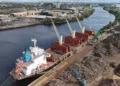

Republic Steel’s long-idled mill in Lorain, Ohio, could see a wave of international investment, potentially restoring hundreds of industrial jobs to a city still recovering from years of manufacturing decline. Mayor Jack Bradley confirmed in a Nov. 20 news release that Republic Steel’s parent company, Mexico-based Grupo Simec, has held “encouraging” talks with multiple foreign steelmakers exploring operations at the site.
The renewed interest comes as Section 232 tariffs on imported steel continue to reshape the economics of global steel production. Industry analysts say that while the tariffs were originally implemented in 2018 to protect domestic producers, they have increasingly pushed foreign steelmakers to consider U.S.-based operations as a way to avoid the import duties and secure access to North American customers.
Major Job Creation on the Table
According to early information shared with the city, potential investment could generate between 500 and 1,200 jobs, making it one of the most significant industrial revitalization efforts in northern Ohio in years.
“We are encouraged by the strong interest shown in Lorain as a site for renewed steel production,” Bradley said. He added that Republic Steel is working closely with FirstEnergy to ensure the site can deliver the heavy electrical capacity required for steelmaking operations—an essential step in any reopening plan.
City officials say Lorain’s existing industrial infrastructure, skilled workforce, port access, railway lines, and proximity to State Route 57 give it competitive advantages over other U.S. sites courting similar investment.
A Once-Mighty Mill in Ruin
The Republic Steel mill, once a pillar of Lorain’s industrial economy, has been idle since 2022 after years of downsizing. Staffing had declined to roughly 100 employees by 2016, and by 2024 the site had fallen into significant disrepair.
A News 5 Cleveland investigative report last year showed drone footage of deteriorating structures, collapsed roofs, flooded basements, and vegetation growing inside abandoned buildings. After obtaining a search warrant, the city documented code violations and structural hazards, ultimately involving the Ohio Environmental Protection Agency.
The 435-acre property sits along the Black River and contains the region’s only deep-water port between Toledo and Cleveland—an asset highly attractive to steel producers dependent on bulk material imports and export flows.
Investor Interest Rising as Global Producers Rethink U.S. Strategy
Industry experts say global steelmakers are increasingly exploring U.S. investments as shifting trade policies, supply chain concerns, and rising domestic demand for low-carbon steel reshape long-term strategies.
The U.S. Department of Commerce has maintained Section 232 tariffs on many steel imports, and recent negotiations with the European Union and Mexico have kept market uncertainty high. For companies facing high tariff costs or quota limits, establishing U.S.-based production can provide long-term stability and market access.
In recent years, international steel companies—including firms from India, South Korea, and Europe—have pursued or announced new U.S. facilities, citing similar incentives.
“Given the current tariff environment, operating within the U.S. is often the most efficient path into the North American steel market,” said a Cleveland-based steel industry consultant familiar with the Lorain discussions.
Next Steps
While no formal agreements have been announced, Bradley said the city will continue to work closely with Grupo Simec and potential partners. Additional updates will be released as negotiations advance.
If an investor deal moves forward, the redevelopment of Lorain’s historic steelworks could signal a broader resurgence for heavy industry in the Midwest—driven not only by tariffs, but also by growing demand for U.S.-made steel in electric vehicles, infrastructure, and renewable energy projects.